Williamsburg Homes, With Neighborliness in Mind

When the architect Carmi Bee first moved to Park Slope, Brooklyn decades ago, the favored activity of his neighbors was to lounge on the stoops of their brownstones, getting to know one another.

“Now that the area’s become gentrified, you don’t see it,” Mr. Bee said, and then laughed. “They’re all working to pay the mortgage, I guess.”

Thus, Mr. Bee, a principal of RKT&B Architects and Urban Designers, said he enjoyed designing a group of 12 contemporary row houses in Williamsburg, Brooklyn, that may bring back the former days of stoop-gathering.

Read more on the NYTimes

“THE NEIGHBORHOOD: OUR PLAYGROUND”. Towards the ‘spatial turn’ in Social and Urban Theory.

This book explores the evolution of social and urban theory starting from the classic debate in the 19th century. Far from being a “mere” exploration of different definition of City and Urbanism, the aim of this essay is to focus on a multidimensional understanding of Urbanism as a means to see how different disciplines have faced the relationship between people and place. The conceptual starting point is Lefebvre’s idea of the urban as a universal condition not “simply” or “specifically” related to the city, as the privileged form of sociospatial settlement space. According to this perspective, urbanism cannot be considered as a self-evident object: it is the outcome of different socio-spatial processes, involving multiple levels and dimensions. After defining the conceptual categories of the theoretical field, the essay proposes a reflection on the contemporary challenges in the theoretical construction of the neighborhood concept. A particular attention is to be paid to the practices as an euristic tool to understand the relationship between this three concepts: “structure”, “human” and “practice” which constituted the idea of neighborhood.

Download here a pdf version of the book and an English book review by Federico Savini, UvA.

Here the publisher page: «Il Quartiere: il nostro campo di gioco».Manzo_Campo di Gioco_cover

“THE NEIGHBORHOOD: OUR PLAYGROUND”. Towards the ‘spatial turn’ in Social and Urban Theory.

This book explores the evolution of social and urban theory starting from the classic debate in the 19th century. Far from being a “mere” exploration of different definition of City and Urbanism, the aim of this essay is to focus on a multidimensional understanding of Urbanism as a means to see how different disciplines have faced the relationship between people and place. The conceptual starting point is Lefebvre’s idea of the urban as a universal condition not “simply” or “specifically” related to the city, as the privileged form of sociospatial settlement space. According to this perspective, urbanism cannot be considered as a self-evident object: it is the outcome of different socio-spatial processes, involving multiple levels and dimensions. After defining the conceptual categories of the theoretical field, the essay proposes a reflection on the contemporary challenges in the theoretical construction of the neighborhood concept. A particular attention is to be paid to the practices as an euristic tool to understand the relationship between this three concepts: “structure”, “human” and “practice” which constituted the idea of neighborhood.

Please read more here: «Il Quartiere: il nostro campo di gioco».Manzo_Campo di Gioco_cover

China: home to the world’s least affordable housing markets

Five big Chinese cities rank among the priciest housing markets in the world, surpassing notoriously expensive cities like Tokyo, London and New York, based on calculations by the International Monetary Fund. In fact, seven out of 10 of the world’s least affordable markets–Beijing, Shanghai, Shenzhen, Hong Kong, Tianjin, Guangzhou and Chongqing–are now in China.

[Atlantic Cities, 7/1]

New York’s Chinatown residents feeling the squeeze as population shrinks and land values rise

With its population shrinking and its property values rising, New York’s Chinatown is under siege, according to an exhaustive report released Friday.”Gentrification threatens to transform these previously neglected neighborhoods into tourist centers and destroy places were Asian immigrants have lived and worked for decades,” said Bethany Li, staff attorney with The Asian American Legal Defense and Education Fund, which authored the report.” [Crain’s NY, 6/21]

Affordable Housing Goes Postal: Turning post offices & empty lots into affordable housing & more.

Last week while talking at CUNY, mayoral candidate Joe Lhota proposed an interesting idea for building new affordable housing: close post offices and use the land to build affordable housing.

Now, while the specifics need some work, it’s a good concept.  Publicly-owned land and buildings that are not fully utilized should be re-purposed for better public use,  with much of it used for one of our most pressing needs – affordable housing.  But “public land” is not a one-size-fits-all designation. Jurisdiction might be with the city, state, or federal governments, or one of many public authorities, such as the Port Authority. And within these entities, dozens of different agencies might control the plots, each agency with its own agenda.

It’s difficult for the city to gain control of Federally- or State-owned land. But the next administration can take one very significant step – a comprehensive survey of city-owned underutilized land, followed up by a citywide plan for disposition and development, as ANHD recommended in its report, Real Affordability: Recommendations to Strengthen Affordable Housing Policy. There are several parcels of city-owned land that would be perfect for building affordable housing except for one thing – the parcel isn’t controlled by the city’s department of Housing Preservation and Development. But the next mayor, with the stroke of a pen, can transfer them to HPD’s jurisdiction, an action that can allow for thousands of units of affordable housing. In fact, if just half of all publicly-owned vacant land were re-purposed for affordable housing, we could generate space for over 100,000 more units – and that’s without even rezoning to allow for larger buildings.

In terms of deciding land use, many vacant or under-utilized parcels might be perfect for much-needed schools, parks, firehouses, qood-paying light manufacturing and industrial jobs,or a myriad of other things that the city needs, but are under the jurisdiction of a different city agency with no plans, or even ability, to utilize them. For instance, HPD has title to several small plots of land that would have a very hard time even hosting a small house and are the only green space in the neighborhood. It’s natural to turn these into parks or community gardens. Larger plots of land, which could easily host affordable housing but are owned by other agencies, could be turned over to HPD to develop.

It’s understandable that the Parks Department wants the land it controls for parks, the Sanitation Department wants its land for sanitation garages or waste transfer stations, and the Department of Education wants its land for schools. But we’re all in this together, and it’s often the case that the plot of land controlled by the Department of Education would be better used as a park, while the plot controlled by the Department of Sanitation would better used as a school. And many, many city agencies have large parcels of vacant or underutilized land that could be used to build much-needed affordable housing. Vacant and underutilized land should be developed according to its best use for the public, not which agency happens to control it.

The next administration needs to kick off this comprehensive survey right away, within the first 100 days of the new administration, in order to quickly and efficiently identify new sites for affordable housing. Post offices are an interesting idea, one which may or may not be proper or feasible, but either way, they’re only a small part of the puzzle.  The real challenge lies in determining how best to use an increasingly valuable and dwindling resource – our publicly-owned land.

Blogger – Moses Gates

ANHD blog team:  Benjamin Dulchin, Moses Gates, Ericka Stallings, Jaime Weisberg, Barika Williams. Anne Troy, editor.

Flux City (loving morphology studies…)

city forms

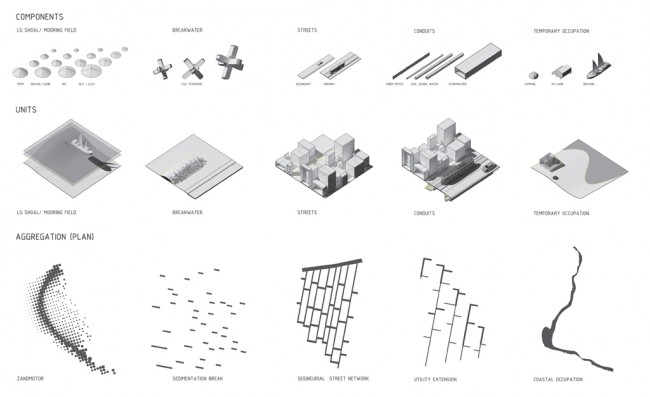
Chris Reed shares work from a Harvard GSD landscape architecture studio that considers how productive ecologies drive the development of urban form and uses Jamaica Bay as a case study for exploring the opportunities of richly fluid territories.

The studio site was Jamaica Bay, an ecologically rich habitat containing many marshy islands, surrounded by highly developed residential and industrial areas including JFK airport, Floyd Bennett Field, and neighborhoods like Marine Park. This varied and vulnerable environment allowed the studio to focus on the development of urban form as driven by productive ecologies and their dynamics — a landscape-based urbanism.

Read more on Urban Omnibus

Visual Approaches to Urban Ethnography. A commentary

This article gives a snapshot on visual sociological methods, spatial semiotics, and visual culture to study the urban scene. Moreover, it would underline that we could treat observations and photographs as we do other information, such as interviews or demographic data which are specific to areas, neighbourhoods, streets, organizational boundaries and census tracts. We should note here that our snapshots attempt to be as close as we can get to what an ordinary person might see as they traverse a space. They are not attempts at artistic representation but are intended to document visual surveys. Indeed, visual sociology and attention to vernacular landscapes in the inner city allow us to see conflict, competition and dominance at a level not usually noticed and which can easily be related to the theories and descriptions of Lefebvre and Bourdieu. Read more on this piece published on the last issue of Urbanities:  «Visual Approaches to Urban Ethnography»

Commentary on Urbanities (2013)

This commentary is part of my ongoing reflection on ethnographic experience and visual methodologies. Some of the issues addressed here were discussed during a workshop (co-authored with Jerome Krase) held in Buenos Aires during the last ISA Visual Sociology Thematic Group conference of August 2012.