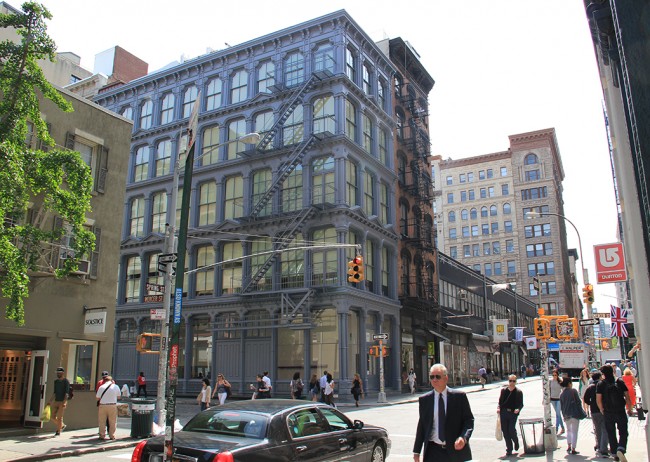
Earlier this summer, New York Methodist Hospital announced that it was planning to expand its facilities, on the eastern portion of the block bounded by 7th and 8th Avenues and 5th and 6th Streets. The hospital presented preliminary plans at a meeting held by Community Board 6 and the Park Slope Civic Council on July 11th (here’s coverage of that meeting via DNAinfo, as well as a more recent update).
Category Archives: Current Issue
“THE NEIGHBORHOOD: OUR PLAYGROUND”. Towards the ‘spatial turn’ in Social and Urban Theory.
This book explores the evolution of social and urban theory starting from the classic debate in the 19th century. Far from being a “mere” exploration of different definition of City and Urbanism, the aim of this essay is to focus on a multidimensional understanding of Urbanism as a means to see how different disciplines have faced the relationship between people and place. The conceptual starting point is Lefebvre’s idea of the urban as a universal condition not “simply” or “specifically” related to the city, as the privileged form of sociospatial settlement space. According to this perspective, urbanism cannot be considered as a self-evident object: it is the outcome of different socio-spatial processes, involving multiple levels and dimensions. After defining the conceptual categories of the theoretical field, the essay proposes a reflection on the contemporary challenges in the theoretical construction of the neighborhood concept. A particular attention is to be paid to the practices as an euristic tool to understand the relationship between this three concepts: “structure”, “human” and “practice” which constituted the idea of neighborhood.
Download here a pdf version of the book and an English book review by Federico Savini, UvA.
Here the publisher page: «Il Quartiere: il nostro campo di gioco».
“THE NEIGHBORHOOD: OUR PLAYGROUND”. Towards the ‘spatial turn’ in Social and Urban Theory.
This book explores the evolution of social and urban theory starting from the classic debate in the 19th century. Far from being a “mere” exploration of different definition of City and Urbanism, the aim of this essay is to focus on a multidimensional understanding of Urbanism as a means to see how different disciplines have faced the relationship between people and place. The conceptual starting point is Lefebvre’s idea of the urban as a universal condition not “simply” or “specifically” related to the city, as the privileged form of sociospatial settlement space. According to this perspective, urbanism cannot be considered as a self-evident object: it is the outcome of different socio-spatial processes, involving multiple levels and dimensions. After defining the conceptual categories of the theoretical field, the essay proposes a reflection on the contemporary challenges in the theoretical construction of the neighborhood concept. A particular attention is to be paid to the practices as an euristic tool to understand the relationship between this three concepts: “structure”, “human” and “practice” which constituted the idea of neighborhood.
Please read more here: «Il Quartiere: il nostro campo di gioco».
Bedford-Stuyvesant record-breaker as apartment goes for $1M
The gentrification of Bedford-Stuyvesant continues.
This week, a two-bedroom apartment on Lexington Ave. went for the Brownstown Brooklyn price of $1 million – a sale that is believed to be a record in the rapidly upscaling neighborhood.”
[New York Daily News, 7/2]
China: home to the world’s least affordable housing markets
Five big Chinese cities rank among the priciest housing markets in the world, surpassing notoriously expensive cities like Tokyo, London and New York, based on calculations by the International Monetary Fund. In fact, seven out of 10 of the world’s least affordable markets–Beijing, Shanghai, Shenzhen, Hong Kong, Tianjin, Guangzhou and Chongqing–are now in China.
[Atlantic Cities, 7/1]
New York’s Chinatown residents feeling the squeeze as population shrinks and land values rise
With its population shrinking and its property values rising, New York’s Chinatown is under siege, according to an exhaustive report released Friday.”Gentrification threatens to transform these previously neglected neighborhoods into tourist centers and destroy places were Asian immigrants have lived and worked for decades,” said Bethany Li, staff attorney with The Asian American Legal Defense and Education Fund, which authored the report.” [Crain’s NY, 6/21]
WRITING THE CITY. Living Lofts: The Evolution of the Cast Iron District
Yukie Ohta looks at the dramatic transformation of SoHo over the past 50 years, from a center for light manufacturing, to a desolate and dangerous wasteland, to one of the most affluent neighborhoods in New York.
Read more on the Urban Omnibus:
http://urbanomnibus.net/2013/06/living-lofts-the-evolution-of-the-cast-iron-district/
Native New Yorkers Better at Finding New York Apartments. (Actually I don’t think so…)
La riGenerazione a #Milano inizia dai Giovani! #MIGeneration @FDVLAB
Questo post è in italiano, soprattutto perchè parla di Milano e delle sue giovani generazioni.
Ieri, venerdì 17 maggio, con un concerto alla Fabbrica del Vapore in cui si sono esibiti tra gli altri i rappers Mondo Marcio, Vacca e Babaman, ha preso il via la prima edizione di ‘MI Generation’, il festival del protagonismo giovanile di Milano. L’iniziativa terminerà a fine settembre col ‘MI Generation Camp’, il Forum delle Politiche giovanili della città e sulla città.
Io, che vivo questa città da quando sono nata, la sento per la prima volta “partecipare” e mi piace che questa partecipazione passi per seminari pubblici come quello organizzato al Politecnico lunedì 20 maggio, o attraverso linguaggi universali come la musica, meglio ancora utilizzando il RAP.
La riGenerazione non può che iniziare dai giovani, perchè è attraverso i giovani che speriamo si inneschi il cambiamento di questa Milano, una città che deve iniziare a riflettere su cosa siano oggi cittadinanza, seconde generazioni e intercultura. (Thanks to G.Lab, festival riGenerazioni e Icei)
Is Generation Y a ‘Game Changer’ for Housing?
Many housing observers agree that Generation Y-people from 18 to 34 years of age-largely prefers downtown living, often in rental apartments with easy access to walkable neighborhoods and public transportation.
The real question is whether they’ll outgrow those tastes once they earn higher salaries and have kids.
[Wall Street Journal, 5/15]